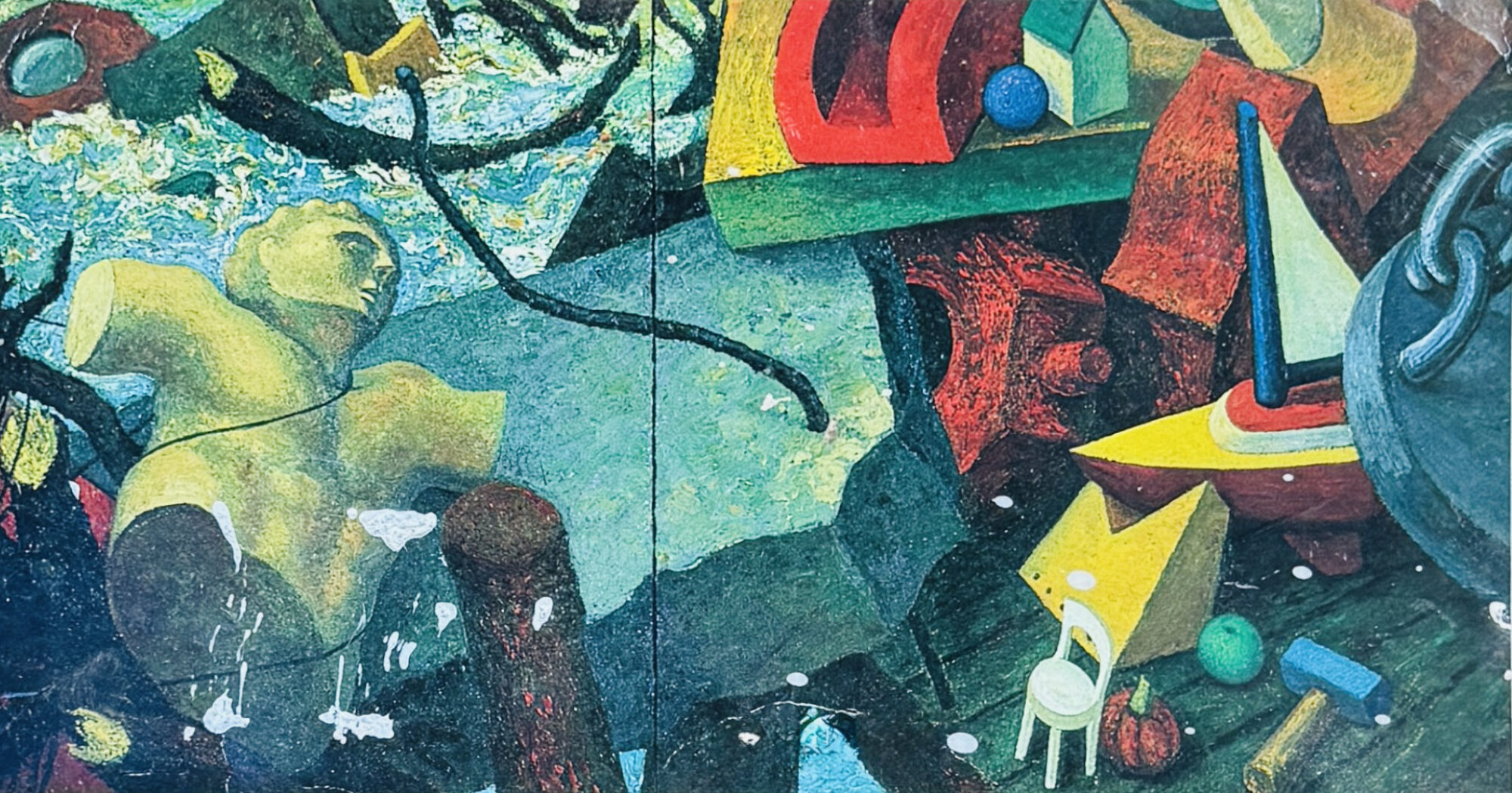
Banner Image: Robert Jessup, Deluge and Salvage, 1985
Barbara Matilsky developed a deep connection to nature during summers at her grandparent’s bungalow colony in the Catskill Mountains. The calm of laying down in mossy outcrops and thrill of surveying land from tree tops inspired her spirit for exploration.
Nicholas Roerich, Tibet Himalayas, 1933, tempera on cavas, 29 x 46 in., Nicholas Roerich Museum, New York
When Barbara later discovered the beauty of landscape painting in the Metropolitan Museum of Art, her professional career path began to crystallize. For her PhD thesis at New York University’s Institute of Fine Arts, she researched the relationship between 19th century alpine and polar images and the emerging field of natural science.
During her thirty years as a museum curator, Barbara organized exhibitions that address the intersection of art, natural history, and environmental issues. In 1986, she began her career at the Queens Museum of Art in New York City. Here she organized several exhibitions, including Classical Myth and Imagery in Contemporary Art and Fragile Ecologies: Contemporary Artists’ Interpretations and Solutions that toured the United States with the Smithsonian Institution Traveling Exhibition Service.
In 1996, Barbara was appointed Curator of Exhibitions at the Ackland Art Museum, University of North Carolina Chapel Hill, where she organized more than twenty wide-ranging exhibitions, including Buddhist Art and Ritual in Nepal and Tibet, Five Artists-Five Faiths: Spirituality in Contemporary Art, and Illuminations: Contemporary Film and Video Art.
Mariko Mori, video clip from Kumano, 1998-1999
George Catlin, Buffalo Bull, Grazing on the Prairie, 1832–1833 Oil on canvas 24 x 29 in. Smithsonian American Art Museum.
As the first art curator of the Whatcom Museum’s Lightcatcher building from 2009-2018, Barbara organized the international traveling exhibition, Vanishing Ice: Alpine and Polar Landscapes in Art 1775-2012 and Endangered Species: Artists on the Front Line of Biodiversity.
Jyoti Duwadi, Himalaya to Cascadia: Transcending Boundaries, Western Gallery, Western Washington University, Bellingham
Barbara recently curated the retrospective exhibition, Jyoti Duwadi, Himalaya to Cascadia: Transcending Boundaries for Western Washington University’s Western Gallery in 2023. In 2024, she began organizing a series of exhibitions, Women Rising, in conjunction with the Cascadia International Women’s Film Festival in Bellingham, Washington.
REFLECTIONS OF A CURATOR / ART HISTORIAN
I can trace my first meaningful art experience to the fourth grade when my mother took me to the Metropolitan Museum of Art to see paintings by the French Impressionists. I was awed by their shimmering colors and seemingly magical compositions. But it wasn’t until my second year in college at the State University of New York at Albany that I knew my life would revolve around the arts.
At first I was keen on becoming a lawyer dedicated to social justice issues. But after attending a philosophy course illustrated with slides of artworks referencing the history of ideas, I was intrigued. I could look at works of art and learn about the world. During my Introduction to Art History class, the professor presented images of paintings by Caspar David Friedrich. His Moonrise over the Sea mesmerized and transported me into a sublime other world. I experienced the sensation of actually being in the painting and, at that point, began charting my professional career.
Caspar David Friedrich, Moonrise over the Sea,1822
Attending New York University’s Institute of Fine Arts (IFA), I received a stellar education by professors, some of whom worked at the Metropolitan Museum of Art and the Museum of Modern Art. I also believe that living in New York City profoundly influenced the direction of my career. When not in class, I spent my days exploring museums and galleries. At the time, I did not realize that I was training my eye, determining how artworks looked in relationship to each other. Most importantly, I began thinking about how to tell a story through art. I was not interested in concentrating on a particular artist, but rather on a work’s cultural context as it related to the important social and environmental issues of the time.
Francois-Auguste Biard, Greenlanders hunting walrus, view of the Polar Sea,1841
One afternoon, Robert Rosenblum, my mentor at the IFA, shared a photo of a surreal arctic landscape by Francois Auguste Biard (1799-1882) that was exhibited in the 1841 Paris Salon. He wisely counseled that Caspar David Friedrich’s art was well renowned, but Biard was on nobody’s radar. I could make a significant contribution to the field if I centered my work around his.
In 1980 I lived in Paris for almost a year while researching my doctoral dissertation: Sublime Landscape Painting in 19th Century France: Alpine and Arctic Iconography and its Relationship to Natural History. I scoured the archive to find information about Biard and discovered documents that led me to that artist’s majestic mural project at the Museum of Natural History. In 1985, I published an article about Biard’s work in the Gazette des Beaux Arts titled, Francois August Biard: Artist-Naturalist-Explorer. According to contemporary scholars who are delving more deeply into his paintings, my work helped lay the foundation for their own in-depth study.
This early research was instrumental in formulating the Vanishing Ice: Alpine and Polar Landscapes in Art 1775-2012 exhibition. The show debuted at the Whatcom Museum and traveled to the El Paso Museum of Art, McMichael Canadian Art Collection, and the Glenbow in Calgary.
Jyoti Duwadi, Melting Ice Installation, 2013, Whatcom Museum, WA
While studying at the Institute of Fine Arts, I interned at the Drawing Center when it was still a fledgling institution on 137 Greene Street under its founder Martha Beck. Collaborating with a grants writer, I learned about fundraising by spending many hours researching at New York City’s Foundation Center (now called Candid). During this period, The Metropolitan Museum of Art hired me to fan out into New York City’s boroughs and present slide lectures at high schools and colleges on the Treasures of Tuthankhamun exhibition in 1976. I also helped research the work of Edward Hopper for the Whitney Museum of American Art where curator Gail Levin was organizing the exhibition Edward Hopper: Prints and Illustrations (1979). For a while, I taught art history as an adjunct professor at various institutions, including Montclair College and Pace University.
1
Queens Museum, New York City
After receiving my PhD in 1986, I became curator at the Queens Museum of Art in New York City where I organized a series of exhibitions beginning with The Heroic Spirit: Classical Sculpture from Ancient Greece to Michelangelo (1986). The works were drawn from the Metropolitan Museum of Art’s 19th century plaster cast collection that was rescued from deterioration and subject to an intensive restoration project.
Alexander Kosolapov, Hero, Leader, God,1985
Exhibition announcement
In order to create a contemporary context for understanding the importance of the cast sculptures, I selected work from 40 artists for the exhibition, Classical Myth and Imagery in Contemporary Art (1988). The show, included Jim Dine, Audrey Flack, George Segal, Leon Golub, Nancy Spiro, and Mary Beth Edelson and offered viewers provocative interpretations and diverse media.
In 1990 I curated The Expressionist Surface: Contemporary Art in Plaster that presented another avenue for appreciating the Metropolitan Museum of Art’s cast collection. Supported by a grant from the National Endowment for the Arts, it showcased the work of 16 artists, including Peter Agostini, Manuel Neri, George Segal, Grace Knowlton, Rudolph Serra, and Jonathan Silver, who used plaster in diverse and unexpected ways.
Exhibition announcement
During this period, I became increasingly alarmed by the state of the environment. My final exhibition at the Queens Museum of Art, Fragile Ecologies: Contemporary Artists’ Interpretations and Solutions (1992), was accompanied by a catalogue published by Rizzoli. The show was developed for circulation by the Smithsonian Institution Traveling Exhibition Service (SITES) and coincided with the inauguration of the museum’s renovated space by Rafael Vinoly.
Fragile Ecologies: Contemporary Artists’ Interpretations and Solutions, 1992
Lesley Dill, Poem Dress, 1992, copper, 40 x 45 x 1 in.
One of my favorite activities as curator was traveling through the boroughs and making studio visits on Fridays. This laid the foundation for an Emerging Artists series, which presented the first exhibitions of work by many talented people, including Lesley Dill and Philemona Williamson.
After my seven-year tenure at the Queens Museum, I journeyed to Nepal where I collaborated with Jyoti Duwadi on an exhibition and written manifesto, Myth of the Nagas and the Kathmandu Valley Watershed, 1993. Inspired by the work of artists featured in Fragile Ecologies, we created an ecological artwork that drew attention to Kathmandu Valley’s deteriorating forests and watersheds. Sponsored by the Asian Development Bank, it was presented at Bhrikuti Mandap, a popular exhibition hall and park in Kathmandu.
Myth of the Nagas and the Kathmandu Valley Watershed was the first ecological and public art installation in Nepal. It marked a homecoming for my partner Jyoti who began returning regularly to Kathmandu to create public art installations, exhibit at the Siddhartha Art Gallery, and participate in several Kathmandu Triennial art exhibitions.
Myth of the Nagas and the Kathmandu Valley Watershed Installation
Living in Nepal, I was drawn to the spirituality of Buddhist and Hindu arts and rituals that defines the culture. The realization that art could become an intrinsic part of everyday life impacted my curatorial career.
2
Ackland Art Museum, University Of North Carolina, Chapel Hill
After returning to the United States and living in New York City, Jyoti and I moved to Chapel Hill in 1996, where I was appointed Curator of Exhibitions at the Ackland Art Museum, University of North Carolina, Chapel Hill. During my 13-year tenure, I organized exhibitions that were often drawn from the museum’s extensive permanent collection as well as borrowed from artists, galleries, and other arts institutions.
My first exhibition, Circles of Divinity: Cross Cultural Connections, opened in 1997. I selected artwork from the culturally diverse permanent collection that highlighted how the circle and spiral – forms embedded in the natural world – appear in all spiritual traditions. From a photograph by Minor White and painting by Hans Hoffman to a Chinese Neolithic Funerary Urn and 16th century Indian painting, the exhibition was richly diverse in media and culture. One of the highlights of the exhibition included a site-specific installation titled Honoring Circle, by the Cherokee artist Sara Bates.
Sara Bates, Honoring Circle, 1997
Another exhibition that I later curated, Buddhist Art and Ritual from Nepal and Tibet (2002-2004), was a multi-year project conceived for the Ackland Museum’s Asian Art Gallery. During this time, I collaborated with Ray Williams, the museum educator, who conceptualized and initiated the on-going Five Faiths Project that explores the world’s major religions through art.
Catalog cover
Once the installation was in place, three monks from the Namgyal monastery traveled to North Carolina to create and later disassemble a large sand mandala for the center of the gallery. Record attendance and community participation in the final ceremony paralleled the university-wide interdisciplinary programming that complemented the exhibition experience.
Contemporary Nepali artist Deepak Joshi from Kathmandu was commissioned to paint a tanka in the gallery for visitors to observe the process of construction. Titled Chakrasamvara and Vajravarahi, it was later purchased for the museum’s permanent collection.
My final exhibition related to the Five Faith’s Project explored the relationship of contemporary artists to global spiritual traditions. Museum staff believed that Five Artists-Five Faiths: Spirituality in Contemporary Art (2004-2005) could help advance conversation and learning about diverse religions. It included Helene Aylon’s installation borrowed from New York City’s Jewish Museum; a video projection by Kimsooja; drawings and light sculpture by Ahmed Moustafa; Panela Singh’s black and white photographs painted with oil, gold, mud and vermillion powder; and Stephen Antonakis’ site-specific installation with three neon panels.
Catalog cover
The Ackland Art Museum benefitted from a large endowment set aside to purchase art for the permanent collection. In addition to my exhibition related work, I made regular monthly visits to New York City to scout out contemporary art for the collection. To justify purchases, I presented their relationship to the collection as a whole. Did it fill a gap, complement an existing work, or represent a new intriguing style or idea? Most importantly, was it visually engaging and did it strengthen the collection as a whole. I will always be grateful for this experience as it enabled me to stay connected to New York City’s vibrant cultural life.
Cover for After Icebergs with a Painter: A Summer Voyage to Labrador and Around Newfoundland, 1861, by Louis Legrand Noble
During this period, I became increasingly aware of the negative impact of global climate change. I had always loved the landscape paintings of Frederick Edwin Church (1826-1900) who, along with Caspar David Friedrich (1774-1840) Joseph MW Turner (1775-1851) and Francois Auguste Biard (1799-1882) introduced audiences to the enchanting world of ice. I could never have imagined that these artists — along with contemporary artists – would later provide insight into the alpine and polar regions ravaged by climate.
The idea of an exhibition devoted to vanishing ice took hold. In 2008, Jyoti and I embarked on a 2,000 mile journey to trace the path of Frederic Edwin Church’s expedition to Newfoundland and Labrador. We wanted to explore and see for ourselves the contemporary state of icebergs and began reading “After Icebergs with a Painter (1861) by Louis Legrand Noble, a writer-poet invited by Church to document his journey. We would also commemorate the upcoming 150-year anniversary of this significant voyage in an essay, In Search of Icebergs.
Frederic Edwin Church, The Icebergs, 1861
3
Lightcatcher, Whatcom Museum, Bellingham, WA
Jyoti and I moved across the continent in 2009 to Bellingham, Washington where I became curator at the Whatcom Museum’s brand new Lightcatcher building. It offered an exciting opportunity to create exhibitions for a beautiful museum designed by Seattle architect Jim Olson. As an added bonus, I lived close to the glaciers of the Pacific Coast Range which could be prominently viewed from my living room windows. I have sadly watched them struggle for survival amid our changing climate.
John Grade, Bloom: The Elephant Bed, 2009
I curated a wide range of exhibitions over the course of almost 10 years at the Whatcom Museum. For the Lightcatcher’s inaugural exhibition, Out of Bounds, I selected work from the wide-ranging collection of Driek and Michael Zirinsky. Many of their paintings and sculptures were created by Pacific Northwest artists with whom I was not familiar. I was particularly drawn to work by John Grade and commissioned him to create a site-specific installation for the museum’s majestically tall entry gallery. Titled Bloom: The Elephant Bed, it referenced the microorganisms whose outer shells of calcium formed England’s white cliffs of Dover.
Soon after my arrival, I became acquainted with David F. Martin, a prominent Seattle art dealer and curator who introduced me to both the renowned and under-recognized artists of the Pacific Northwest. He helped me stage my second exhibition, Show of Hands: Northwest Women Artists 1880-2010. This show purposefully coincided with the centennial of women’s suffrage in Washington State, a right granted ten years prior to the Nineteenth amendment to the United States constitution.
Installation view of Show of Hands: Northwest Women Artists 1880-2010
In 2011, I was thrilled to work once again with Lesley Dill whose exhibition Poetic Visions: From Shimmer to Sister Gertrude Morgan stunningly defined the Lightcatcher gallery. The announcement card said it all: “When the words of New England poet Emily Dickinson and the life of New Orleans folk artist and preacher Sister Gertrude Morgan come together with two million feet of hair-fine wire, the Hindu-inspired “tongue of God,” a few mystical mediations and a couple of lavish ball gowns in one light-filled space, it is worth a look.”
Installation view of Poetic Visions: From Shimmer to Sister Gertrude Morgan, 2011
The highlight of my curatorial practice in Washington was the traveling exhibition, Vanishing Ice: Alpine and Polar Landscapes in Art 1775-2012. Here I was able to synthesize my graduate school research with the current state of the planet. Connections with my first traveling exhibition, Fragile Ecologies, also became poignantly clear.
Installation view of Vanishing Ice at Whatcom Museum
In 2013, I visited Portland Oregon to select artwork for an exhibition drawn from the collection of Jordan Schnitzer and his family collection. After two days studying a wide variety of images from their archive, I spent a long time pondering a theme that would offer an abundance of color and thematic variety.
Radical Repetition: Alberts to Warhol featured recurring imagery in art since the 1960s that led to unexpected stylistic transformations and reinvigorated content. Focusing on prints, the exhibition highlighted both representational and abstract art. It underscored the innovative potential of repeating imagery for a wide range of artists and approaches to art making.
Installation view of Radical Repetition, 2014
One of my favorite exhibitions that I curated for the Lightcatcher, Unhinged: Book Art on the Cutting Edge (2015-2016), explored that limitless potential of the book as an independent artistic medium. Featuring the work of 60 prominent artists, it represented an extraordinary array of innovative artworks.
Doug Beube, Border Crossing: In the War Room, 2006, altered atlas, thread, zippers, piping, metal, wire 48 × 48 × 5 in.
Preston Singletary, Killer Whale, 2009 Blown glass and sand-carved glass, 25 x 16 x 7 in., Collection of Museum of Glass, Tacoma, Washington
Soon after Vanishing Ice, I began planning what would become my final exhibition for the Whatcom Museum, Endangered Species: Artists on the Front Line of Biodiversity (2018-2019). Here, climate change intersects with artists who call attention to habitat loss, invasive species, population growth, pollution of land, water, atmosphere, and the promise of seed banks.
In closing, I am extremely grateful to the museums and donors who supported my trilogy of exhibitions – Fragile Ecologies, Vanishing Ice, and Endangered Species – that document artists’ contributions to issues that are vital to our survival.